Table of Contents
- Executive summary
- The legal reality: transparency is mandatory, privacy is non-negotiable
- “Just blur the face” breaks down in the first 30 seconds
- Automation helps, until it doesn’t, and then defensibility matters
- What “defensible” means: auditability, QA, and evidence integrity
- The cost reality: redaction time is real, and error costs are irreversible
- Best-practice recommendations agencies can implement now
- FAQs
Executive summary
Public-sector transparency is increasingly delivered through video: body-worn cameras, in-car systems, fixed surveillance, interview rooms, and “citizen video.” But the same footage that strengthens accountability can also expose victims, bystanders, juveniles, medical details, addresses, license numbers, and other protected data—often in fleeting frames or spoken audio.
Across U.S. frameworks like FOIA and state public-records laws (examples here include CORA and CPRA), a consistent operational expectation emerges: release what can be released, and withhold only what must be protected, often by redaction rather than blanket denial. At the federal level, agencies are also expected to apply a presumption of openness and consider discretionary releases when appropriate, guided by the “foreseeable harm” standard.
The practical conclusion for records units, police leadership, legal counsel, and privacy advocates is the same: video redaction for FOIA must be operated like an auditable evidence process, not a casual editing task. This article explains why, what “defensible redaction” looks like in 2026, and how a hybrid workflow, automation plus human verification, reduces both privacy risk and records-backlog pain.
The legal reality: transparency is mandatory, privacy is non-negotiable
This post uses FOIA (federal) and two state analogs—CORA (Colorado) and CPRA (California)—as reference points; the specific jurisdiction for your agency is unspecified, and local statutes, case law, and body-camera-specific disclosure rules can materially change what must be released, when, and with what redactions.
At the federal level, FOIA requires agencies to provide any reasonably segregable portion of a record after deleting exempt portions, and it directs agencies to indicate deletions and the exemption basis when feasible. California’s CPRA contains a closely parallel segregability rule (Government Code § 7922.525, amended effective January 1, 2025).
In Colorado, CORA is commonly summarized by state agencies as providing that public records are open for inspection unless specifically made not public by law. But operationally—especially for policing—records regimes can fork: the Denver, for example, notes that release of police records is governed by the Colorado Criminal Justice Records Act and that some reports may be releasable with required redactions. (This is a concrete reminder that “CORA vs. police video” can be jurisdictionally nuanced.)
FOIA’s disclosure orientation is also sharpened by the presumption of openness and the “foreseeable harm” standard articulated in Office of Information Policy guidance from the U.S. Department of Justice. Practically, this pushes agencies toward narrow, explainable redactions rather than broad withholding when public interest is high and privacy harms can be mitigated.
Privacy advocates have long emphasized why that mitigation matters: body cameras can capture sensitive moments inside homes and expose victims and bystanders in high-stress situations. The stakes are not abstract. In early February 2026, officials in Providence released redacted body-camera video and audio from the police response to the Brown University shooting, describing the challenge of balancing transparency with sensitivity to survivors.
“Just blur the face” breaks down in the first 30 seconds
Video redaction looks simple until you quantify it. The standard frame rate in which body-worn cameras capture video is 30 frames per second. That means one hour of footage can exceed 100,000 individual frames, each a potential privacy leak.
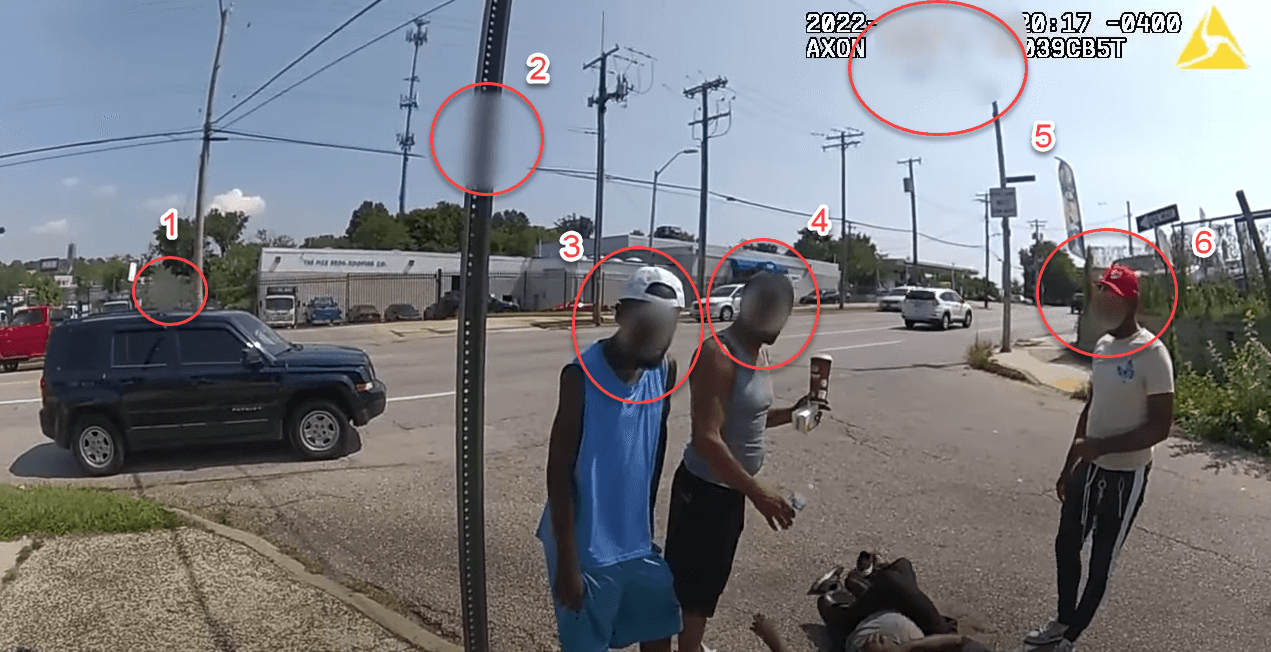
Modern guidance and technical literature emphasize why “faces and plates” are only the beginning. A Bureau of Justice Assistance-hosted white paper calls redaction one of the most urgent needs for departments adopting body cameras, warns that traditional redaction (e.g., blurring faces and plates) is only a first step, and notes that sensitive identifiers can appear in both visual and audio streams, logos, contextual cues, and location indicators included.
And then there are the realities of field footage: fast motion, low light, side profiles, partial occlusions, and the “gotchas” that humans notice and algorithms miss—like reflections in mirrors or windows. A Focal Forensics best-practices guide explicitly calls out mirror reflections as an example of subtle details that can reveal a face and therefore require manual attention as a safety net. Audio complicates it further: names, addresses, medical information, and other sensitive data can be spoken clearly even when the camera isn’t pointed at a person.
For records officers and counsel, the key takeaway is analytical: redaction is not a single detection problem; it is a continuity problem. You’re not trying to find one face, you’re trying to guarantee that every appearance of a protected element is covered across time, angles, reflections, and audio.
Automation helps, until it doesn’t, and then defensibility matters
Automation is indispensable at scale, and the public sector is explicitly planning for it. The BJA white paper describes “automatic detection and redaction” of classes of entities (faces, logos, license plates) and even “automatic acoustic privacy filters.” But the same report delivers a blunt warning that applies directly to public release: current performance often does not meet body-camera needs because even a single missed face or license plate can be costly in FOIA servicing contexts.
Academic and applied work supports that caution. A 2024 open-source research effort on automated face blurring notes that automated techniques can be excessive, inconsistent, or insufficient, each posing a serious privacy risk, and frames manual blurring as ground truth in validation. Separately, forensic-oriented evaluation of deep-learning face detectors shows a recurring tradeoff: speeding up detection (e.g., by resizing) reduces accuracy, and the computational demands may not suit large-scale forensic workloads without careful engineering choices.
Vendors building “assisted redaction” capabilities increasingly describe the same operational reality: machine learning can generate editable boxes for common sensitive elements, but workflows still emphasize reviewing detections, managing false positives, fixing missed frames, and exporting a defensible report.
The upshot is not “don’t automate.” It’s this:
Automation is a first pass. Defensibility comes from verified, documented second passes.
Comparison of redaction approaches
| Approach | Speed | Accuracy | Defensibility | Cost | Scalability |
|---|---|---|---|---|---|
| Manual (all-human) | Slow | High when expertly staffed | High if documented consistently | High labor cost | Low |
| Automated (tool-only) | Fast | Variable; errors cluster in hard scenes | Weak without verification and logs | Lower labor but higher error risk | Medium–High |
| Hybrid (automation + human verification + QA) | Medium–Fast | High (verification catches misses) | High (auditable process) | Balanced | High |
What “defensible” means: auditability, QA, and evidence integrity
Defensible redaction is not defined by how “good” a blur looks. It is defined by whether an agency can explain, reproduce, and stand behind the process under appeal, litigation, or public scrutiny.
Federal FOIA text makes the philosophy explicit: release segregable portions after deleting exempt material, and indicate deletions and their exemption basis when feasible. The Chief FOIA Officers Council best-practices guidance on video redaction adds operational clarity: plan early, choose the right tool, assign the right people, and budget appropriately, because waiting for the first major request creates rushed, imperfect solutions.
Technical defensibility also depends on evidence integrity and documentation. National Institute of Standards and Technology guidance recommends hashing digital objects with approved algorithms and storing hashes separately as a best practice for integrity. The Scientific Working Group on Digital Evidence similarly emphasizes maintaining chain of custody and creating detailed contemporaneous notes, including software employed, logs, and hash values.
The cost reality: redaction time is real, and error costs are irreversible
Agencies often discover that redaction costs scale with complexity, not just length.
A Police Executive Research Forum cost study reports an operational example where redaction consumed about one hour of staff time for 10 minutes of video, with time varying based on what must be redacted. In the same report, Dallas staff estimated 15–30 minutes to redact routine traffic-accident videos, closer to a 1:1 effort ratio for that narrower use case.
More recent municipal costing shows how agencies quantify the work. A revised 2024 Seattle Police Department cost study describes time studies for targeted video and audio redaction and reports a salary-based estimate of roughly $0.80 per minute of redaction time (excluding benefits and overhead), with targeted video redaction estimated in part by “minutes per individual or object redacted.”
Errors, meanwhile, are uniquely punishing because disclosure is often irreversible. In 2023, local reporting described unredacted body-camera footage from the Murdaugh trial being released by mistake due to a misunderstanding, prompting subsequent efforts to seal the evidence. The lesson is not sensational; it is structural: without controlled versioning, QA, and release gates, one administrative slip can defeat months of careful privacy protection.
Best-practice recommendations agencies can implement now
Start with governance: define what must be protected, who decides, and how decisions are documented. FOIA and CPRA both embed the logic of segregating releasable content from exempt content rather than defaulting to withholding.
Treat video as a multi-stream record. Build workflows that explicitly review visual identifiers (faces, plates, logos, unique contextual cues) and audio identifiers (names, addresses, medical details), because sensitive information often moves across channels.
Adopt hybrid redaction as a default operating model. The BJA body-camera analysis warns that even one missed face or plate can be costly, while FOIA video-redaction best practices stress planning, tools, and staffing—together implying that automation without verification is not a safe design for public release.
Make QA visible and measurable. Focal Forensics describes a process that includes final review and quality control as a distinct step, reflecting how mature programs separate “doing the redaction” from “proving it’s correct.”
Harden defensibility with integrity controls: preserve originals, hash at ingest, log tooling and edits, maintain chain-of-custody documentation, and ensure released versions are traceable to a controlled workflow.
Finally, budget with realism. Federal guidance to FOIA programs explicitly says agencies must identify the right tools, people, and budget for video redactions—and warns that waiting leads to scrambling under statutory or court-ordered timelines.
Call to action: If your agency is facing rising video-request volume, tighter timelines, or higher privacy risk, contact Focal Forensics for a redaction-readiness assessment—an applied review of intake triage, secure ingest, hybrid redaction workflow, QA gates, audit logging, and release practices. Focal Forensics publicly describes secure handling, quality control, and a structured redaction process designed for public-sector use cases.
FAQs
What is video redaction for FOIA?
Video redaction for FOIA is the process of removing or obscuring legally protected information from government video records before public release. This may include faces, license plates, juvenile identities, medical details, addresses, and sensitive audio statements, while releasing all reasonably segregable portions of the footage.
What does “reasonably segregable” mean in FOIA video releases?
FOIA requires agencies to release any portion of a record that can be reasonably separated from exempt information. In video redaction, this means removing protected elements while preserving releasable content rather than withholding the entire recording.
How many frames must be reviewed in body camera footage?
Most body-worn cameras record at 30 frames per second. One hour of footage can exceed 100,000 individual frames, each potentially containing sensitive information that must be evaluated for redaction.
Is automated video redaction accurate enough for public release?
Automation is helpful for detecting common elements like faces and license plates, but it is not sufficient on its own. Even one missed frame can expose protected information. Best practice is a hybrid model combining automated detection with human verification and QA.
What makes video redaction “defensible”?
Defensible video redaction means the agency can document and explain:
What was redacted
Why it was redacted
What legal authority justified the redaction
What tools and processes were used
That quality assurance was performed
Audit logs, hash verification, version control, and QA review are key components.
How long does it take to redact body camera footage?
Redaction time depends on complexity, not just length. Agencies often report ratios ranging from 1:1 (for routine footage) to 8:1 or higher for complex scenes with multiple protected elements requiring frame-by-frame review.
What types of information must typically be redacted from police video?
Common redactions include:
Juvenile faces and identities
Victims of certain crimes
Medical or mental health information
Home interiors and sensitive locations
License plates and driver’s license numbers
Social Security numbers
Spoken personal identifiers
Specific requirements vary by jurisdiction.
How should agencies document their redaction process?
Agencies should:
Preserve the original file
Hash the original for integrity
Log software and workflow steps
Document exemption rationale
Conduct final QA review
Maintain chain-of-custody records
Documentation is critical if a release decision is challenged.
When should an agency consider outsourcing video redaction?
Agencies may consider outsourcing when:
Request volume exceeds internal capacity
Deadlines are statutory or court-ordered
Staff lack specialized redaction training
QA error risk is high
A defensible, auditable process is required
Professional redaction vendors can provide secure workflows, hybrid review processes, and documented QA gates designed for public-sector compliance.